
Cotton country in Texas doesn't give you many second chances. Whether you're farming the Rolling Plains, the High Plains, or the Coastal Bend, your planting window is tight, your soils are unforgiving, and a poor cotton stand can cost you the whole season before the crop ever gets going.
Cotton stand establishment, which is how well your cotton comes up and how uniform it is across the field, sets the pace for your yield potential. No amount of fertility, irrigation, or pest management can fully recover a thin or uneven stand. That's why the equipment you plant with matters as much as the seed you put in the ground.
John Deere planters are built to give Texas cotton producers the precision and reliability needed to hit the ground running every spring. Let’s take a look at how.
Explore John Deere Planting Equipment
The foundation of a good stand is simple: every seed needs to be placed at the right depth, with consistent soil contact, every time. John Deere's ExactEmerge and MaxEmerge 5e row units deliver that kind of precision across the variable soils Texas ranchers deal with, from sandy loam to heavy clay soil.
Individual row-unit downforce adjusts automatically as conditions change across a field, so you're not fighting the planter every time the soil type shifts. Depth control wheels and proper setup keep seeds in the target zone, which is typically 1 to 1.5 inches for cotton, without over-penetrating or floating above where the moisture is.
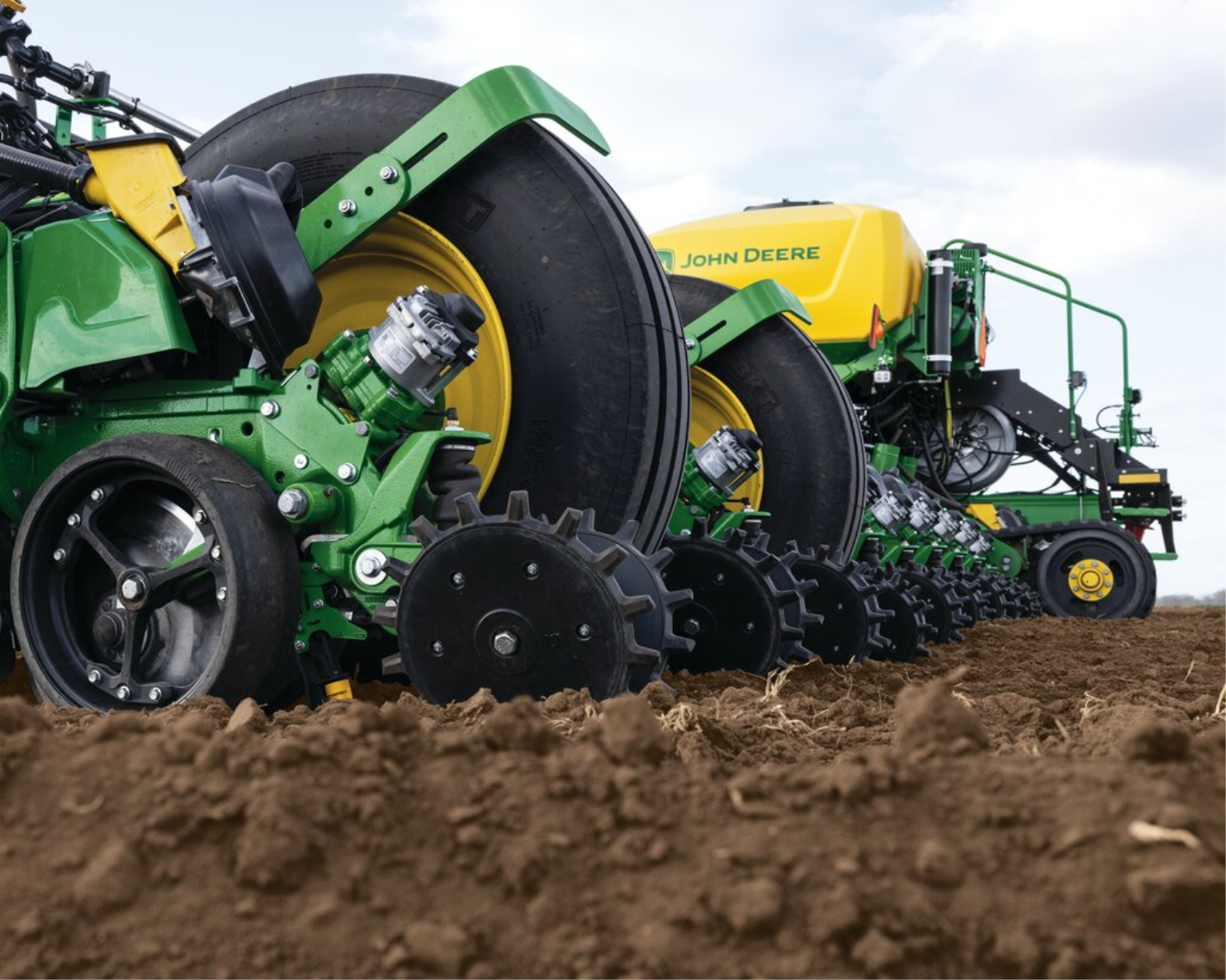
Skips and doubles are cotton stand killers. A skip means a gap in your row. A double means two seeds competing for the same real estate. Either one costs you.
ExactEmerge technology places seeds at precise, consistent spacing with virtually no bounce or misplacement, even when you're running at higher speeds. That means uniform plant populations across your field and less intrarow competition as the season progresses.
Pair that with John Deere's variable rate seeding capability through the Operations Center, and you can dial in population by prescription zone within a single field, putting more seed where your soils can support it and pulling back where they can't.
Texas ranchers know the planting window doesn't wait. When soils finally hit that 65°F threshold at planting depth and conditions line up, you need to move. ExactEmerge planters maintain singulation accuracy at speeds up to 10 mph, so you can cover more acres without giving up the placement quality that stand establishment needs.
A Texas rainstorm right after planting can crust the soil over and trap seedlings before they ever break the surface. John Deere planters with integrated closing wheel options — cast iron, spiked, or rubber — let you match your closing setup to your soil conditions and reduce the risk of crusting becoming a problem.
Even with the best planter setup, stand issues happen. The John Deere Operations Center lets you review planting maps after the field is done, spotting population gaps before they become bigger decisions. JDLink telematics can help diagnose row unit issues in-season, so if something goes wrong mid-field, you know about it.
Contact Us About Precision Ag Solutions
Technology only works when it's set up right for your operation. At Tellus Equipment Solutions, we work with Texas ranchers across cotton country to match the right planter configuration to your soils, your seed, and your farm’s size.
If you're heading into a cotton planting season and want to make sure your planter is dialed in, stop by your nearest Tellus location or reach out to our team. We're here to help you get the stand you're counting on.
Cotton stand establishment refers to how consistently and uniformly cotton seeds germinate and emerge after planting. A good stand means the right plant population per acre with even spacing down the row. A poor stand — caused by uneven depth, inadequate seed-to-soil contact, or soil crusting — limits your yield potential for the entire season and can force costly replanting decisions.
Most Texas cotton producers target a planting depth of 1 to 1.5 inches, depending on soil moisture and temperature. Seeds should never go into ground that hasn't reached at least 65°F at planting depth. Planting too shallow risks poor germination; planting too deep delays emergence and increases stress on the seedling.
John Deere ExactEmerge row units place seeds at precise, consistent spacing with minimal bounce or misplacement, even at planting speeds up to 10 mph. This reduces skips and doubles across the row, resulting in a more uniform stand and less intrarow competition as the crop develops.
Both deliver reliable seed placement, but ExactEmerge is designed for higher-speed planting with individual seed delivery that maintains accuracy at faster ground speeds. MaxEmerge 5e is well-suited for operations that prioritize proven, consistent performance across a wide range of conditions. Your Tellus equipment specialist can help you determine which row unit fits your operation.
Yes. Tellus Equipment Solutions carries John Deere planting equipment and serves Texas ranchers and row crop producers across the state from more than 25 locations. Our team can help you select, configure, and service the right planter setup for your cotton operation. Contact your nearest Tellus location to get started.
.svg)
.png)
.png)
.svg)